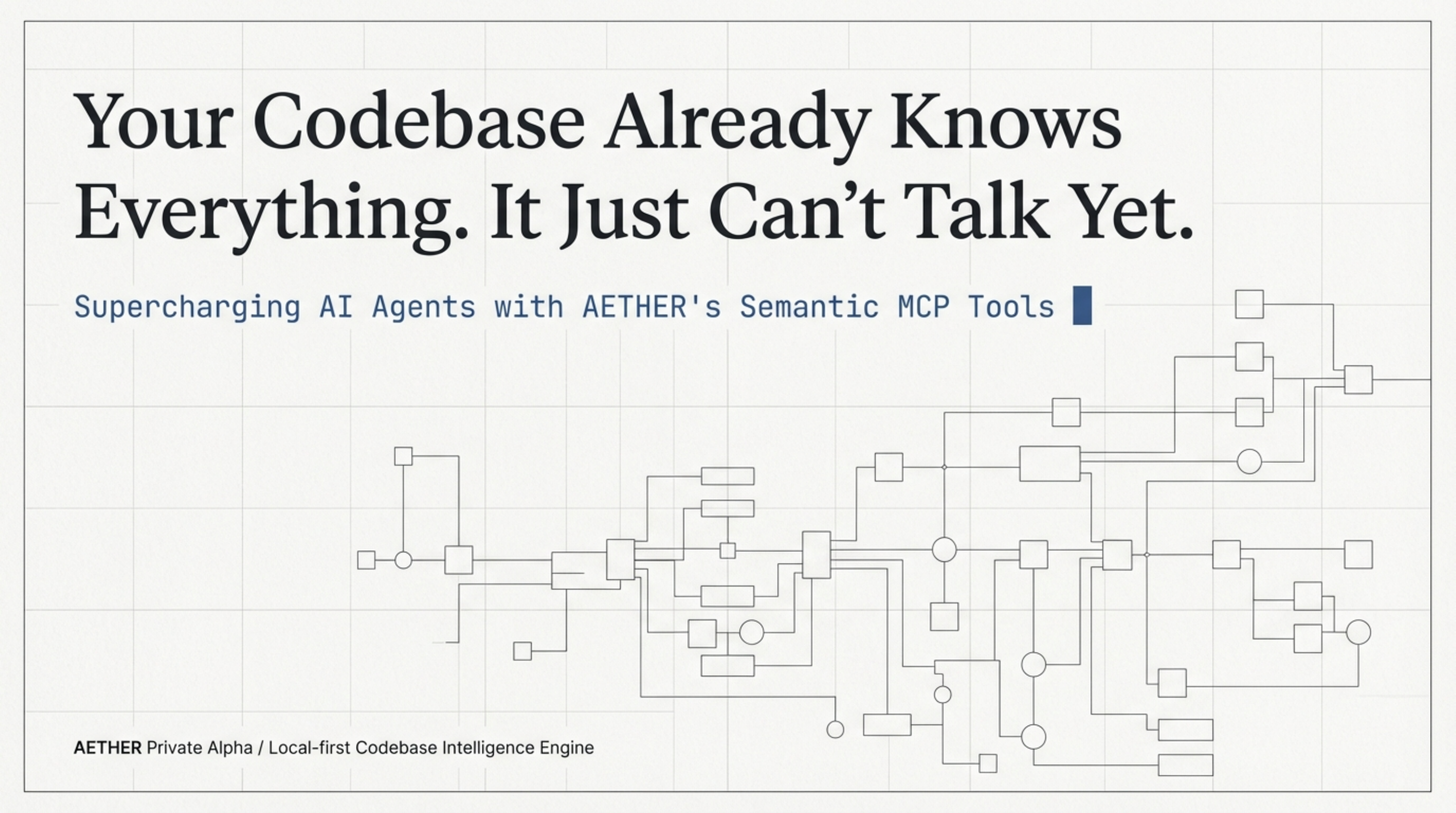
Your codebase already knows everything. It just can't talk yet.
“What is it? I think it's some kind of offline online context engine vector temporal quantum something or other.”
See it in action
Listen: AETHER gives your codebase a voice
What is it?
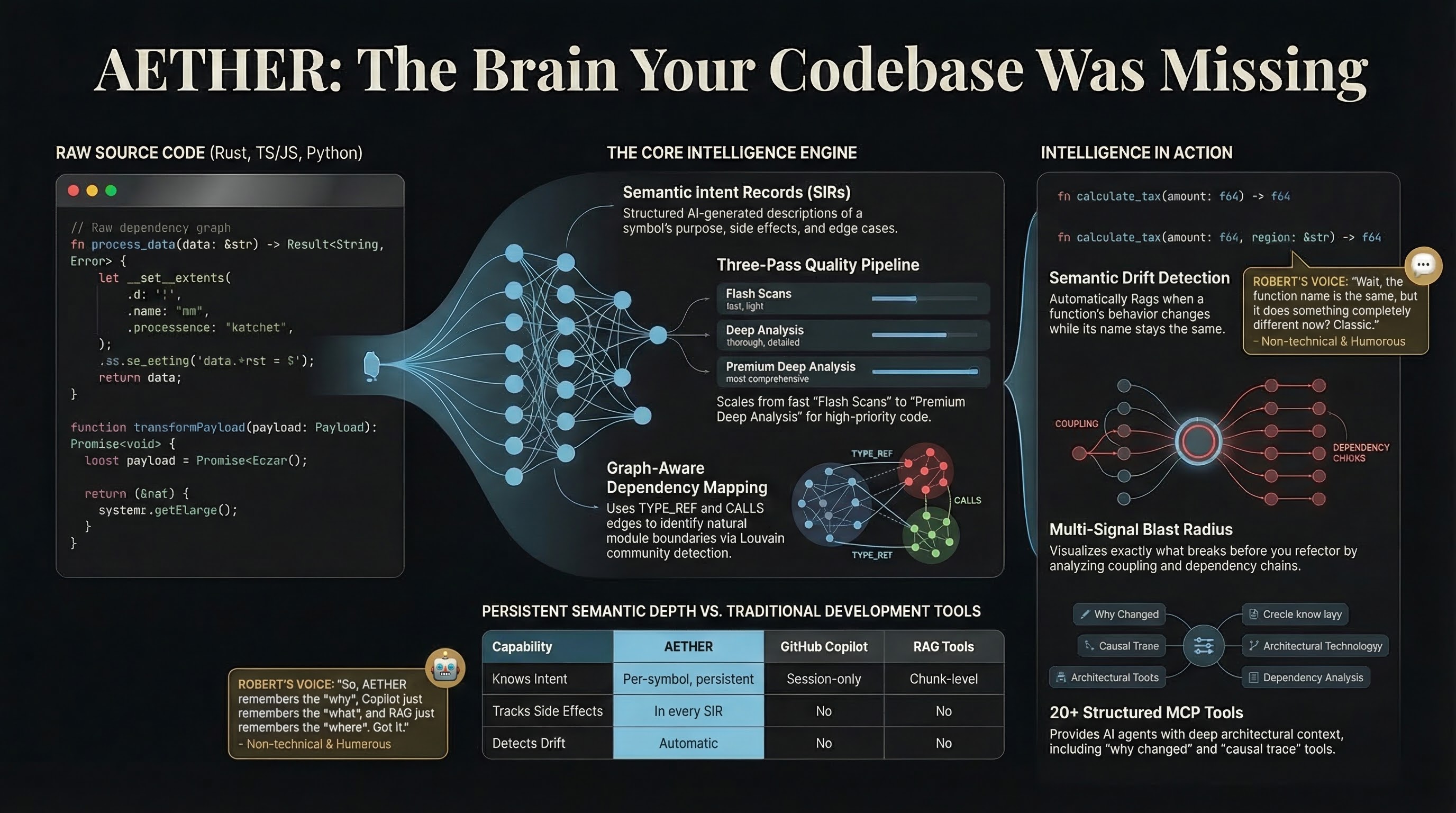
"I think it's some kind of offline online context engine vector temporal quantum something or other."
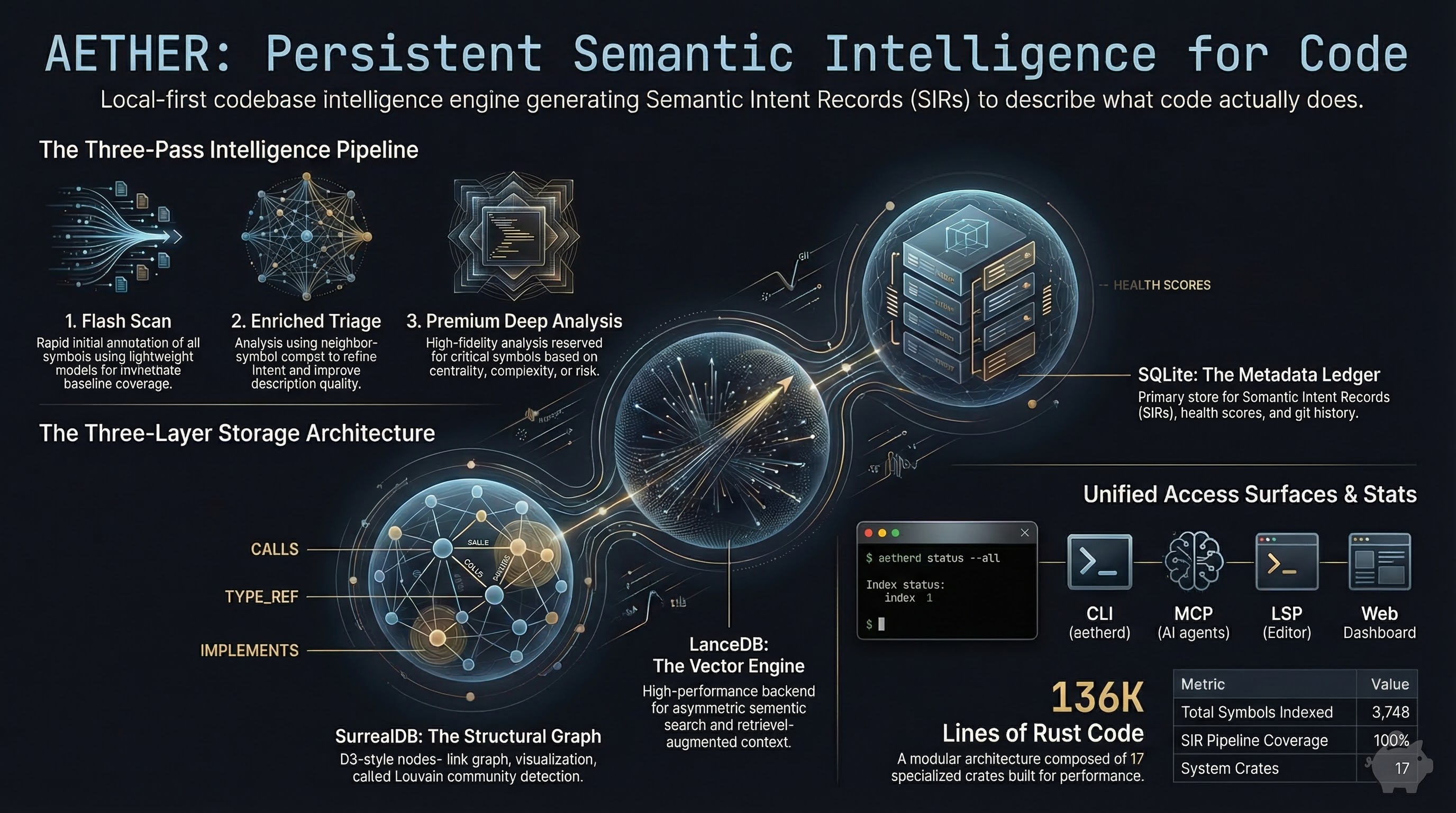
AETHER generates Semantic Intent Records for every symbol in your codebase — structured descriptions of what functions actually do, their side effects, edge cases, and dependencies. These persist across sessions, update incrementally, and version with your git history.
"I don't get these coding languages, I would just call that a bird"
Tree-sitter AST parsing across Rust, TypeScript/JavaScript, and Python. Your React app, your CLI tool, your API server — same pipeline.
"I think there's an MCP server in there"
20+ structured MCP tools with typed schemas. Your AI agent doesn't just see code — it understands intent, risk, and blast radius.
AETHER's semantic intelligence architecture
“Look, you want databases? I think I've got at least three.”
Features
"I've got at least three databases"
SurrealDB for the structural graph. SQLite for metadata and vectors. LanceDB as a vector backend option. They talk to each other.
"I've got your front end right here"
Web dashboard with 15+ pages. D3 visualizations. Health scoring. Drift timelines. Coupling heatmaps. Blast radius explorer.
"I'm making them DBs clap"
Three-pass quality pipeline: flash scan → enriched triage → premium deep analysis. Gemini Embedding 2 with asymmetric task types.
"It works on your React stuff too"
Parses Rust, TypeScript/JavaScript, and Python. Point it at your Next.js project and find out which components are actually dangerous.
"Something about graphs"
Structural dependency graph with CALLS, TYPE_REF, and IMPLEMENTS edges. Louvain community detection. PageRank centrality scoring.
"I broke it up into little packages"
17 crates with clear single responsibilities. ~136K lines of Rust. 327 commits. 109 merged PRs. Built by one person.
“I think there's an MCP server in there somewhere”
MCP Tools
20 tools. Your AI agent doesn't just see code — it understands intent, risk, and what breaks if you touch something.
Core Intelligence
aether_searchHybrid lexical + semantic search across your entire codebase
aether_symbol_lookupFind any symbol by name, path, or pattern
aether_explainGet a plain-English explanation of what a symbol does
aether_get_sirPull the full Semantic Intent Record — purpose, side effects, edge cases
aether_why_changedSee how a symbol's meaning evolved between commits
aether_symbol_timelineFull version history with git linkage
Project Memory
aether_rememberStore architectural decisions, gotchas, context — with deduplication
aether_recallSearch everything you've stored
aether_session_noteQuick context capture during coding sessions
aether_askUnified search across code intelligence + notes + history
Analysis & Risk
aether_blast_radius"What breaks if I change this?" — multi-signal coupling analysis
aether_healthComposite health scoring: structural + git + semantic dimensions
aether_drift_reportDetect when code meaning silently changed
aether_acknowledge_driftMark known drift as intentional
aether_trace_causeRoot cause tracing through causal change chains
aether_test_intentsWhich tests actually guard this symbol?
aether_call_chainTrace outgoing call chains N levels deep
aether_dependenciesShow who calls this and what it depends on
aether_verifyRun configured verification commands with structured results
aether_statusWorkspace health check — symbol count, SIR coverage, provider info
The full walkthrough
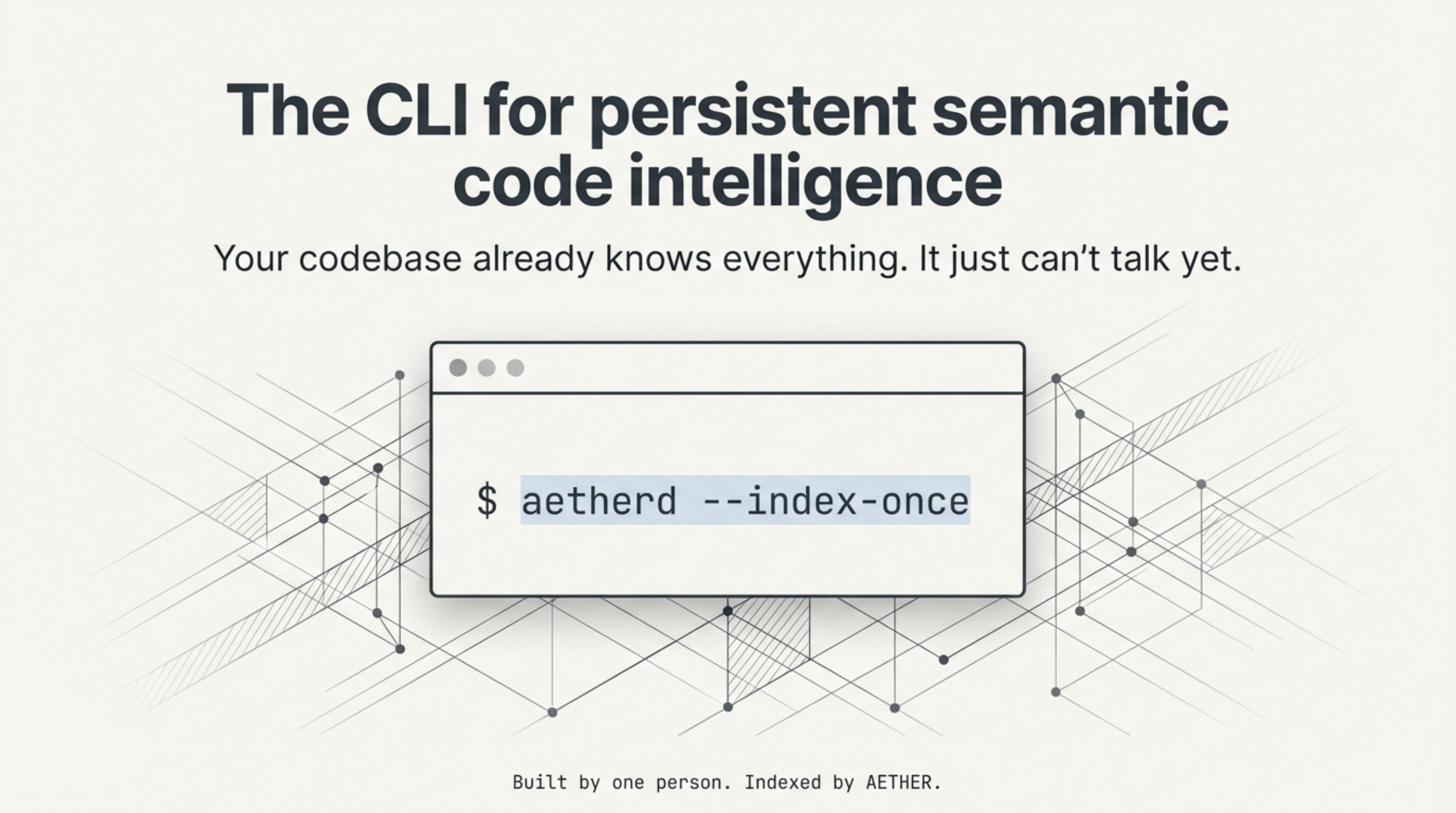
“Or just use the command line like a normal person”
CLI
Getting Started
$ cargo install aetherd
$ cd your-project && aetherd --index-once
$ aetherd search "what handles authentication?"
Search & Query
$ aetherd search "payment validation" --search-mode hybrid --limit 10
$ aetherd ask "how does pub/sub work in this codebase?"
$ aetherd recall "why we chose SurrealDB"
Project Memory
$ aetherd remember "Chose SurrealDB over Neo4j — embedded, no external process"
$ aetherd recall "database decision"
$ aetherd notes --limit 20
Analysis
$ aetherd blast-radius src/payments/processor.rs
$ aetherd drift-report --window "50 commits" --min-drift 0.15
$ aetherd health
$ aetherd trace-cause process_payment --depth 4
$ aetherd communities --format table
$ aetherd coupling-report
Server Modes
$ aetherd --workspace .                    # Index + watch (daemon)
$ aetherd --workspace . --lsp --index      # LSP with background indexing
$ aether-query serve --index-path .        # MCP-over-HTTP query server
Every command, explained
“Hover over anything. I dare you.”
Editor Integration
AETHER plugs into VS Code via LSP. Mouse over any symbol and see what your editor has been hiding from you.
validate_payment_amount
src/payments/processor.rsValidates transaction amounts against account limits and available balance. Returns typed error for each failure mode.
Logs to audit trail on rejection
Zero amount → InvalidAmount, negative → InvalidAmount, exceeds balance → InsufficientFunds, overflow → AmountOverflow
78/100| Drift: None
5/7 edge cases guarded
src/payments/gateway.rs (0.87)
“Chose rust_decimal over f64 — precision requirement from Payment Gateway v2 spec”3 weeks ago
What your editor actually shows you
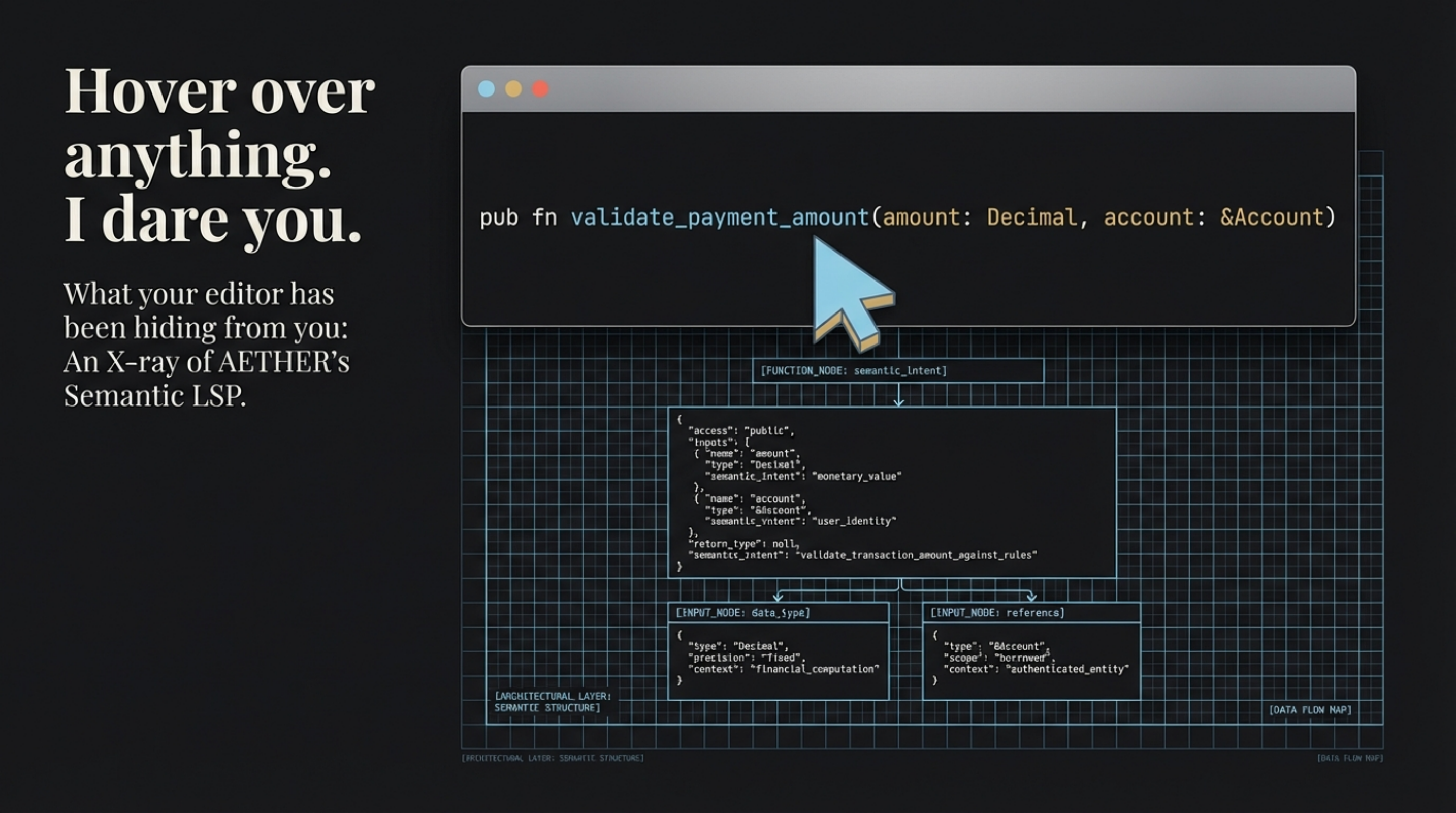
Intent, not just types
See what a function means, not just its signature
Risk at a glance
Health scores, drift warnings, and test coverage gaps right in the tooltip
Memory built in
Relevant project decisions and coupling data surface automatically
Two lists. One tool.
Whether you actually know what you're doing or you're just vibing with AI, AETHER has you covered.
If You're a Programmer
- 1
Know what every function actually does
SIRs describe intent, not just signatures
- 2
Find code by meaning, not names
"what validates payments" works even if the function is called check_amt
- 3
See what breaks before you break it
Blast radius analysis before every refactor
- 4
Detect silent drift
When someone changes what a function does without changing its name
- 5
Trace root causes through the graph
Not just "what changed" but "what caused the change"
- 6
Health-score your codebase
Structural + git + semantic dimensions, not just line counts
- 7
Community detection on real dependencies
Louvain clustering on TYPE_REF + CALLS edges, not file proximity
- 8
Version your intent, not just your code
SIRs version with git history
- 9
Run it offline
Ollama + local models, no cloud required
- 10
Give your AI agent actual context
20 MCP tools, not just "here's a file"
If You're a Vibe Coder
- 1
Ask it what your code does
Because honestly, do you even know?
- 2
Find that one function
You know, the one that does the thing with the stuff
- 3
Check if you're about to break everything
Before your AI breaks it for you
- 4
Remember decisions you made at 2am
Project memory persists across sessions
- 5
Explain your code to your code
Let AETHER be the one who understands it
- 6
Get a health report
Like a doctor's visit for your repo
- 7
See the dependency spaghetti
Graph visualization of what calls what
- 8
Track when AI changed your function's meaning
Because it will
- 9
Works with Rust, TypeScript, Python
Whatever your AI is generating today
- 10
Three commands to start
cargo install, index, search. That's it.
It analyzed itself. Then it fixed itself.
aether-store/src/lib.rs — 6,817 lines. AETHER flagged it as a God File. Health score: 42/100.
Same LLM (OpenAI Codex) given the same refactoring task twice.
| Aspect | Blind (no AETHER) | With AETHER |
|---|---|---|
| Modules proposed | 15 | 13 |
| Grouping basis | Name similarity | Proven dependency clusters |
| Evidence used | Just the source code | TYPE_REF edges + community detection + SIR intents |
0 → 0
lines (façade)
1 → 0
focused modules
RESOLVED
God File archetype
Each tool was given the same refactoring task and scored on plan quality (1–10).
6.0
Gemini
8.0
ChatGPT 5.4 Xhigh
9.25
ChatGPT 5.4 Xhigh + AETHER MCP
“AETHER then re-scanned itself and confirmed the improvement. The tool that diagnosed the problem validated the fix.”
Comparisons
“How it compares”
| Capability | AETHER | grep/ripgrep | GitHub Copilot | RAG tools |
|---|---|---|---|---|
| Knows function intent | Per-symbol, persistent | ✗ | Session only | Chunk-level |
| Tracks side effects | In every SIR | ✗ | ✗ | ✗ |
| Detects semantic drift | Automatic | ✗ | ✗ | ✗ |
| Works offline | Ollama + local everything | ✓ | ✗ | Depends |
| Graph relationships | TYPE_REF, CALLS, IMPLEMENTS | ✗ | ✗ | Basic |
| Health scoring | Structural + git + semantic | ✗ | ✗ | ✗ |
| Survives restart | Fully persistent | ✓ | ✗ | Partial |
Things AETHER does that literally no other tool does
Not “does better.” Does at all.
Semantic Intent Records
Every symbol gets a structured description of WHY it exists: purpose, side effects, edge cases, dependencies. Not comments. Not docstrings. AI-generated, cross-symbol-enriched, versioned intelligence.
Closed-loop self-analysis
AETHER can analyze its own codebase, diagnose problems, guide the fix, and verify the result. No other tool validates its own recommendations.
Three-pass quality pipeline
Flash scan for speed, enriched triage with cross-symbol context, premium deep analysis for critical symbols. The enrichment pass is the secret weapon — context matters more than model size.
TYPE_REF structural edges
Not just "who calls who" but "which functions use which types as parameters and returns." This is what makes community detection actually work on real code.
Asymmetric embeddings
Documents and queries are embedded differently using Gemini Embedding 2's native task types. Code goes in as RETRIEVAL_DOCUMENT, searches come in as CODE_RETRIEVAL_QUERY.
Graph-aware community detection
Louvain clustering on real structural edges (CALLS + TYPE_REF + IMPLEMENTS), not filename proximity or directory structure. Identifies natural module boundaries your code is already organizing around.
Semantic drift detection
Automatically detects when a function's behavior changed but its name didn't. The silent killer of codebase understanding.
Causal chain tracing
Not just "what changed" but "what caused the change" traced through the dependency graph across commits.
Intent versioning
SIRs version with your git history. See how a function's purpose evolved over time, not just its code.
I need people to break this thing.
Request early access. Got a repo? Even better — drop the URL and we'll prioritize your codebase.
Three commands. That's it. (Coming soon.)
$ cargo install aetherd
$ cd your-project && aetherd --index-once
$ aetherd search "what handles authentication?"
AETHER is in private alpha. These commands will work when we ship. For now — request early access and we'll set you up personally.